
The Forest is Growing: Early Signs of Success in Our Rainforest Restoration Trials
Each day on the land at ClimateForce, the work is about more than planting trees. We are rebuilding an ecosystem, one seedling at a time, and our latest ecological monitoring data now shows clear, measurable signs that our organic rainforest restoration is taking hold.
Tracking the Forest’s Return
From the earliest restoration trials, our team has followed rigorous ecological survey protocols based on the Repairing the Rainforest framework (Goosem & Tucker, 2013). This well-regarded guide has informed restoration projects across the tropics, and it underpins the on-ground ecological surveys at our site in Far North Queensland.
Our baseline on-ground monitoring focuses on floristic composition, meaning the variety and abundance of plant species, together with forest structure and the presence of fauna. Our trained field team collects data from fixed-area plots, recording species, abundance and growth stage to build a detailed dataset that can be compared over time.
The Numbers Tell a Story of Hope

One of the most informative indicators of rainforest regeneration is stem diameter at breast height (DBH), a widely recognised measure of forest structure, maturity and biomass accumulation.
DBH is central to how ClimateForce monitors and interprets the ecological development of our planting trials. It gives a tangible, quantitative view of how young trees are establishing, and of how they gradually contribute to the formation of a layered forest canopy.
In our Plant Out 1 trial, the initial baseline surveys showed what we would expect in a newly planted site: a high proportion of small stems, particularly those under 2.5 cm DBH. These slender saplings represented the earliest stage of regeneration, as they adjusted to site conditions, rooted into the soil and began growing upward towards the light.
As the trial progressed, the distribution of stem diameters shifted. More individuals moved into the 2.5 to 5 cm and 5 to 10 cm classes, showing that the young trees were not only surviving but actively establishing. This shift points to the early stages of canopy stratification, as species begin to separate into height classes and take on distinct roles within the structure of the forest.
The most recent rounds of monitoring recorded trees entering the 10 to 20 cm and even 20 to 30 cm DBH classes. These larger diameters indicate that a subset of trees is becoming the dominant structural species that will form the backbone of the developing forest.
This is more than a growth milestone. Trees in the 20 to 30 cm DBH range begin to make a significant contribution to above-ground biomass, carbon storage and habitat complexity. Their presence marks the beginning of vertical layering, a defining feature of mature rainforest, which supports epiphytes, shelters wildlife and helps regulate the microclimate beneath the canopy.
Taken over time, DBH growth shows a forest moving from a planted array of seedlings towards a self-organising living system, one able to support biodiversity, store carbon and withstand environmental stress. It is measurable evidence of what well-designed, adaptive restoration can achieve.
As these trees continue to grow, so does the forest’s capacity to function as a resilient, regenerating ecosystem, and with it the prospect of long-term rainforest recovery.
Experimenting for Faster Regeneration
We trialled two planting densities in Plant Out 1. Plot 2, planted at 3,500 stems per hectare, grew slightly faster than Plot 1 at 2,500 stems per hectare. This suggests that denser planting encouraged quicker vertical growth, driven by competition for light, by interactions within a closer community of species, or by both, with the most vigorous individuals coming through.
Plant Out 2 used a lower density of 1,522 stems per hectare, combined with organic management techniques including specialised mulches, targeted weeding and companion planting. Over the same time frame, these lower-density plots achieved greater DBH growth than the higher-density plots of Plant Out 1. Because the two trials were established at different times and under different site conditions, these factors may also have played a part. Even so, early results suggest that an integrated organic design, alongside careful species selection, can give early forest development a substantial boost.
For large-scale restoration, this points to a promising direction: planting more thoughtfully can be as effective as planting more densely.
The Forest of Tomorrow
While still early in the study, these results give us clear evidence that our trial designs are supporting strong upward regeneration trajectories.
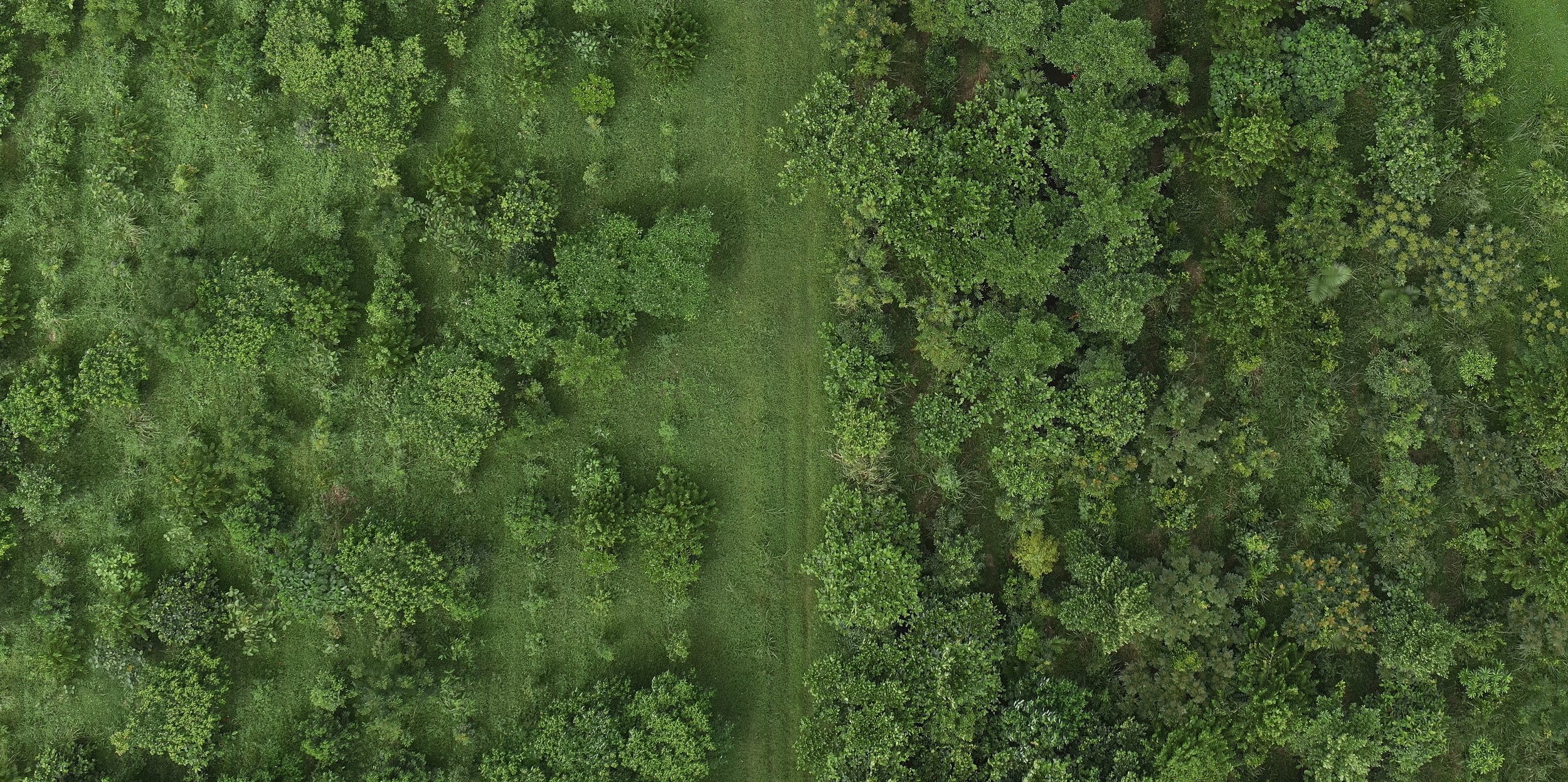
The seedlings we planted just a few years ago are forming young forests with emerging canopy layers. These structures will become critical habitats for returning wildlife and will begin to sequester significant amounts of carbon as the forest matures.
We are eager to continue monitoring whether these early advantages persist as the forest matures and self-thins naturally.
Listening, Watching, and Mapping: The Next Frontier of Monitoring

ClimateForce is broadening its monitoring to capture more dimensions of rainforest recovery.
Bioacoustic monitoring records the living soundscape of the site, from the calls of birds and frogs to the quieter background activity of insects and mammals. These sound signatures will allow us to track biodiversity trends without disturbing the animals themselves.
Camera traps are recording wildlife returning to our plots, from marsupials to rainforest birds, and giving us direct evidence of how animals are using the developing habitat.
High-resolution drone imagery is being processed into canopy height models, which let us measure how quickly our trees are growing and how the forest is developing into complex, layered habitat.
Together, these tools will give us a far more detailed picture of how organic regeneration turns degraded land into a diverse and resilient ecosystem.
Join Us on This Journey
Every data point, every returning species and every growing tree marks progress for nature and for climate action.
Our results show that organic rainforest restoration works, and that rigorous science and careful innovation can speed up ecosystem recovery at scale.
Plant Out 4 is now taking shape, with implementation planned for June 2025. It will be our most integrated system so far, bringing rainforest regeneration together with food-producing agroforestry and extending what land restoration can achieve.
By pairing ecological recovery with resilient food production, we are building our capacity to develop self-sustaining, diversified models of land management that work with natural processes rather than against them.
This work asks us to rethink how human needs and ecological health can be met together, and to design systems in which people and the land thrive alongside each other rather than in competition.
Follow along as the work continues. The forest is growing, and with it the case for what restoration can achieve.

